“I Freaking Can’t Stand “X” Pose”: How to Approach This Yoga Dilemma
Maybe It's Your Body. Maybe It's Your Mind. Perhaps It's Just Not the Right Time, but There's Never a Need to Stress
Few yogis outwardly admit it, but many of us groan inwardly when our guide announces a certain pose.
It’s normal to enjoy some poses more than others. I once had a T-shirt that read, “I only come for savasana,” after all. If you’re like me, though, you might worry too much about the “right” way to approach those poses that feel more “argh” than “aah.” How can you maintain your joy and pleasure in your practice while minimizing those movements that make you uncomfortable?
Yoga is flexible, and there’s no one absolute answer. The approaches below can help you tailor a management strategy suited to your individual needs and preferences.
Get Curious
This approach simply involves asking yourself why you find certain poses distasteful. Curiosity is nearly always a good starting point. It’s pretty tough to solve a problem if you don’t know what’s causing it.
Often, your dislike of a certain pose arises from the physical discomfort it creates. This problem can be the easiest to fix. For example:
- Grab your props: I am all about using straps, blocks, pillows, bolsters, couch cushions, entire couches or chairs, robe sashes, walls, giant stuffed elephants or bears — anything that makes a pose accessible for you. It does not matter how it looks. What’s important is how the pose feels in your body. Furthermore, your need or desire for props may vary by the day, and that’s okay. Meet yourself where you are in the now, not where you wish to be, for a more pleasant yoga experience.
- Ask your guide: While everyone’s body is unique, your yoga guide should have basic training in exercise physiology to suggest safe modifications of poses suited to your frame.
- Adjust your intensity: There’s a considerable difference between holding a chair pose with your knees bent to nearly 90 degrees and one where you hover around 45 degrees. Again, your need or desire for intensity may vary by the day. Avoid forcing poses and meet your body where it is.
Other times, your dislike of certain poses may stem from negative psychological associations. While this experience can be triggering, it can also be empowering; now, you remain in control. You might decide to explore the pose after all, at least when alone or in a safe environment (such as when working with a therapist).
Alternatively, you can also exercise your right to say no and have it be heard. That, in itself, can be healing magic, even if all you're recovering from are the daily slings and arrows of ordinary existence.
Just Say No
If you’ve followed our YouTube show for a while, especially our Saturday Serenity broadcasts, you’ve probably noticed how often I repeat, “Feel free to exit out of any pose that causes discomfort for any reason.”
There’s a good reason for this. Even though I have been guiding yoga since the tender age of 16, I never truly enjoyed the practice until my 40s. That’s because I looked at each session as some sort of test, an endurance contest, a “na na na na boo boo, I can hold this pose longer than you.” I was so focused on doing the physical asanas “right” that I got the focus of the practice all wrong, and missed out on the juiciest benefits, those for your mind and soul.
The beauty part of yoga is that there is no competition.
While you remain free to compete with yourself (more on that in a bit), you won’t be asked to leave the class if you can’t get into a full lotus pose, or even a half one. If you are, that’s a sure sign that particular session is toxic, anyway — I can’t think of a single guide who would call a student out for skipping a pose they didn’t like.
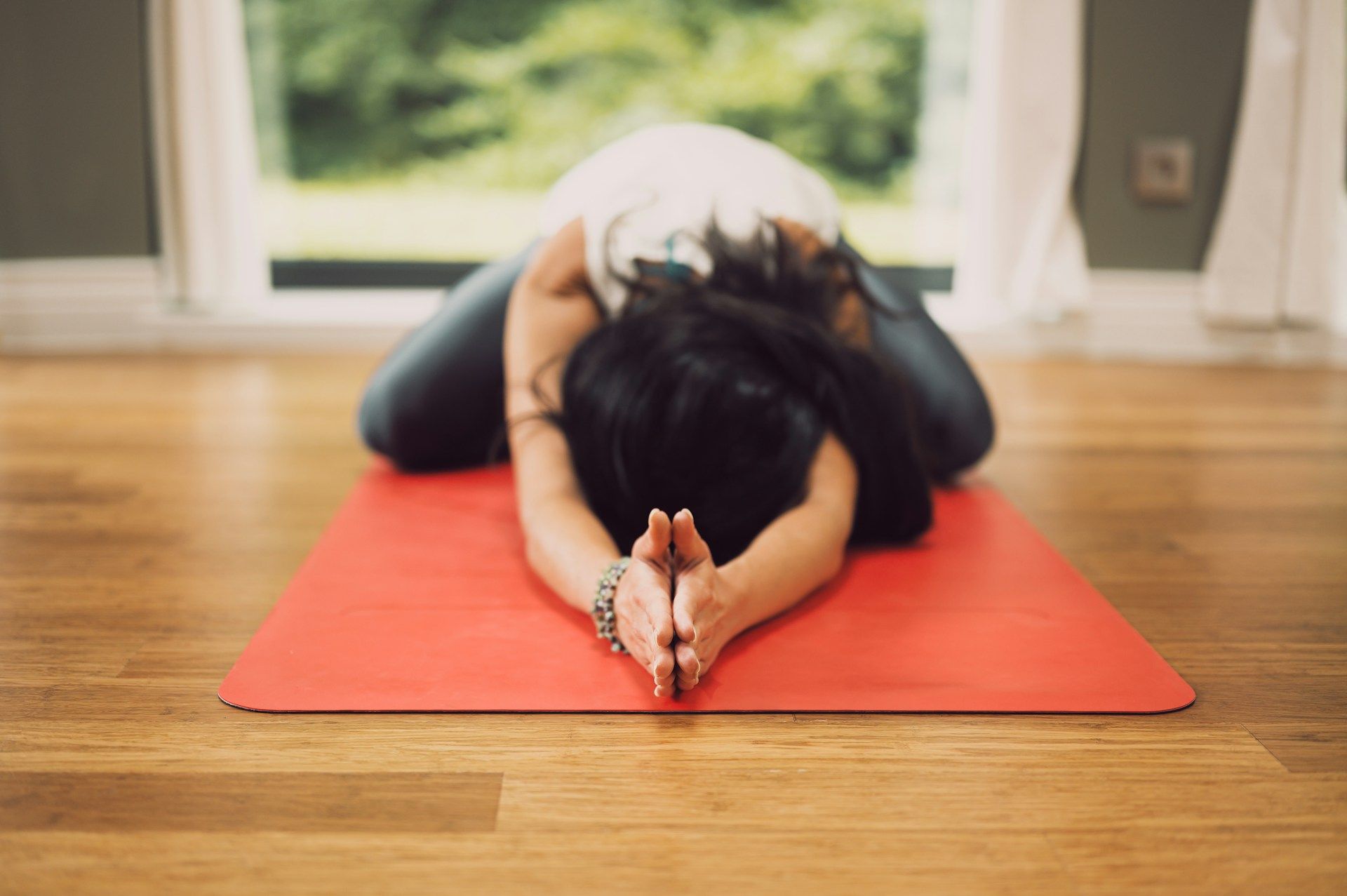
What should you do instead? Etiquette says to avoid distracting those around you when practicing with a group. Therefore, simply take a comfortable seat, maybe even a child’s pose or savasana, depending on the class format.
At worst, your guide may approach you to check if you are okay, at which point you can simply let them know you need to sit this one out. If the thought of being singled out during a session horrifies you, arrive a few minutes early to speak with your guide and inform them of your preference.
If you’re using yoga for trauma recovery, the right to say no to poses you find distasteful is healing. Doing so can help you rebuild a sense of agency. You’re always free to try a pose you don’t like today some other time—but moving at your own pace can restore a sense of control you may have lost.
Try, Try Again
Of course, part of your process of restoring your agency might be to prove to yourself what you can do. Working toward making poses you find challenging easier can also renew confidence in your abilities while teaching you valuable lessons on endurance and not giving up.
I often use the example of getting back into a backbend, or a wheel pose, a challenging posture I don’t often do in class and, admittedly, is still not among my strengths. However, it’s not getting the posture perfect that matters; it’s what the practice taught me along the way.
Physically, I used an inflatable exercise ball until I gathered the requisite upper body strength to push myself up again. Guys, believe me when I tell you, the process of rebuilding those muscles took
forever. I thought I would never be able to do a backbend again and had resigned myself to that fact when I decided to try just one more time — and up I went.
The lesson? I couldn’t care less that I once again have the upper body strength to lift my torso off the ground backward (although muscles do come in handy on our farm).
What mattered was the mental impact of actually having something I worked hard at pay off.
What mattered was the, “I couldn’t do this, but now I can do it, and the reason I can do it is because I kept trying and didn’t give up.”
When you consider that a large part of my trauma originates from my inability to meet my basic human needs for shelter and healthcare no matter how hard I worked, you can better understand the healing power of this moment from my perspective.
Finally, something I had worked for had produced results. I effect positive change in my life, after all.
That’s a hugely empowering lesson for someone whose depression stems from feeling like nothing they had ever done made the least bit of a positive difference.
While skipping poses you can’t stand is sometimes the most empowering choice, especially if it helps you enjoy your overall practice more, working through them can also lead to surprising benefits.
Respect Limits, Embrace Challenge, Practice Balance
I must add a crucial caveat here — sometimes, there are poses you simply should not try pushing yourself into because of your unique physiology and health profile. I’m not going to sit here and pretend that folks who recently had full hip replacements attempt a full lotus pose when even a “comfortable seat” may not feel all that comfortable!
However, your yoga mat is the perfect place for gently challenging your abilities while embracing your natural limitations and learning to work with your unique body. Sometimes, you discover a lot even when you aren’t actively looking.
Your mat can also be the first place you practice setting effective boundaries, including with yourself.
For example, I was so far divorced from my physical experience when I first started talking to my mat in earnest in my early 40s that
I didn’t even realize that half the reason I was depressed all the time was that I physically felt like crap!
On one level, of course, I “knew.” Although I have deleted most of my social media accounts, I was a MySpace baby, and a quick check of whatever arcane electronic records exist from those days will show that I’ve been complaining about mysterious health symptoms since my early 20s — my problems first started
showing up in my teens when I worked a register at a grocery store. I had already applied for, and been denied, disability benefits.
But what I didn’t recognize was
just how much
of my daily bitchiness was directly attributable to continuing to push through a legitimate, albeit untreated, health condition.
I wasn’t inherently Oscar the Grouch.
I was
exhausted and in pain, while being forced to carry a load that was, frankly, too heavy for a perfectly healthy person to manage.
Oddly enough, simply recognizing that fact had a polarizing effect on my mood. As much as taking an honest look at my maladaptive coping mechanisms devastated me with feelings of (deserved) guilt, recognizing that I truly was doing the best that I could do under the circumstances I was dealt was liberating.
Getting genuinely back in touch with my physical reality has been transformative in more ways than I can describe without making this article endlessly long. Suffice it to say, I’m now able to admit, “I’m sorry, I can’t because I don’t feel well.” I can’t choose how the listener reacts to my reality, but I can be authentic about what’s truly going on inside of me instead of trying to mask my frailties to “keep up.” Instead of making other people miserable with my lower energy levels, I can “sit this one out” — both they and I end up happier.
The point is, the mere act of deciding for yourself whether to push through a challenging pose on the yoga mat or sit it out is a part of yoga, a part of growth. One of the most valuable lessons you can learn is how to work with what you’ve got. That’s something even the best guide can’t teach you, but time on the mat can.
Taking a personalized, mindful approach to yoga poses you can’t stand can lead to surprising insights, regardless of whether your limbs ever form certain shapes.