What Should I Do If I Can’t Get Into a Yoga Pose?
It's Utterly Okay to Be a Little Different :)
Your gummy bear instructor makes transforming the human body into a pretzel look as simple as pouring water into a glass. However, your mind says, “yeah, right,” and your body says “heck, no.”
Is it time to roll up your mat in favor of the recumbent bike? While you’re always free to make that choice, there’s no reason to stop talking to your mat. Yoga is for everyone of all ages and abilities, and the right asana variations make it accessible for just about anyone. Here’s what you should do if you can’t get into a yoga pose and why that’s perfectly okay.
Assessing Why You Can’t Get Into a Yoga Pose
You are not a “standard issue human.”
No one is.
Everyone’s bodies contain unique variations, including differences in the configuration of your muscles, bones, ligaments and tendons. Even the ratio ofmuscle to tendon length [1] can vary across different parts of your body. It’s yet another reason that appearances can deceive: you may have the genetics for “show” or good muscle definition without being especially strong. You just have the right configuration for things to “pop” at aesthetically-pleasing places.
The takeaway you should hear loud and clear is: there is
NOTHING wrong with you if you can’t get into a certain yoga pose.
Maybe Your Body Wasn’t Meant to Move That Way, and That’s Okay
It may very well be that your beautiful and unique body simply wasn’t designed to move in that way. Think of how your hip bone sits like a pestle in the mortar of your hip. Your range of motion is inherently limited by the physics of this configuration. Some people really do have naturally smaller, tighter hips than others.
That’s also why you should never force your way into a yoga pose that doesn’t feel right for you. While bones, ligaments, tendons and muscles are living tissue and thus have some give, all solid matter also has a breaking point. Even though many people (myself included) turn to yoga tomanage chronic pain [2], you can make things worse by pushing too hard. Sadly, those who do get injured often shy away from the mat altogether, which isn’t ideal for their long-term mental and physical well-being.
While a lack of flexibility may be the reason you can’t get into a yoga pose, there could also be underlying structural issues you can’t see.
How to Know When a Lack of Flexibility Is the Issue
However, Mother Nature has your back, if you learn to mindfully tune into her via your body’s cues. Stretching only to a point of pleasant tightness will eventually increase your flexibility, gradually, over time, without damaging tissues or tearing anything.
That’s why the best advice I can give you to guide you as to how hard you push yourself is that your practice should always feel like healing medicine. Healing medicine can sometimes feel a bit uncomfortable, breathy, sweaty, even achy, like a deep tissue massage — but it should never make you feel worse than when you started or produce sharp, sudden or fresh pain. Healing medicine can also feel indulgent, like one of our weekly Saturday live yoga and meditation sessions on the Only in Sedona Yoga channel on YouTube.
What Should I Do If I Can’t Get Into a Yoga Pose?
There you are at your favorite yoga class, unable to follow what your guide is doing, but the last thing you want is help with adjustment. What now?
1. Talk to Your Guide
A proactive approach is best. Talking to your guide before class gives you time to assess their style — are they hands on or off — and make your preferences known. Some guides now use red or green index cards to indicate whether or not you appreciate hands-on adjustments or prefer not to be touched.
2. Take Savasana
Taking savasana is a sure sign that you need a time out, and most everywhere should respect it. Your only precaution may be to use care if you’re in a high-energy power class where spreading out could trip other participants, injuring you and them — or if you’re one of those fortunate souls who can fall asleep anywhere.
3. Take Child’s Pose or an Easy Sukhasana Seat
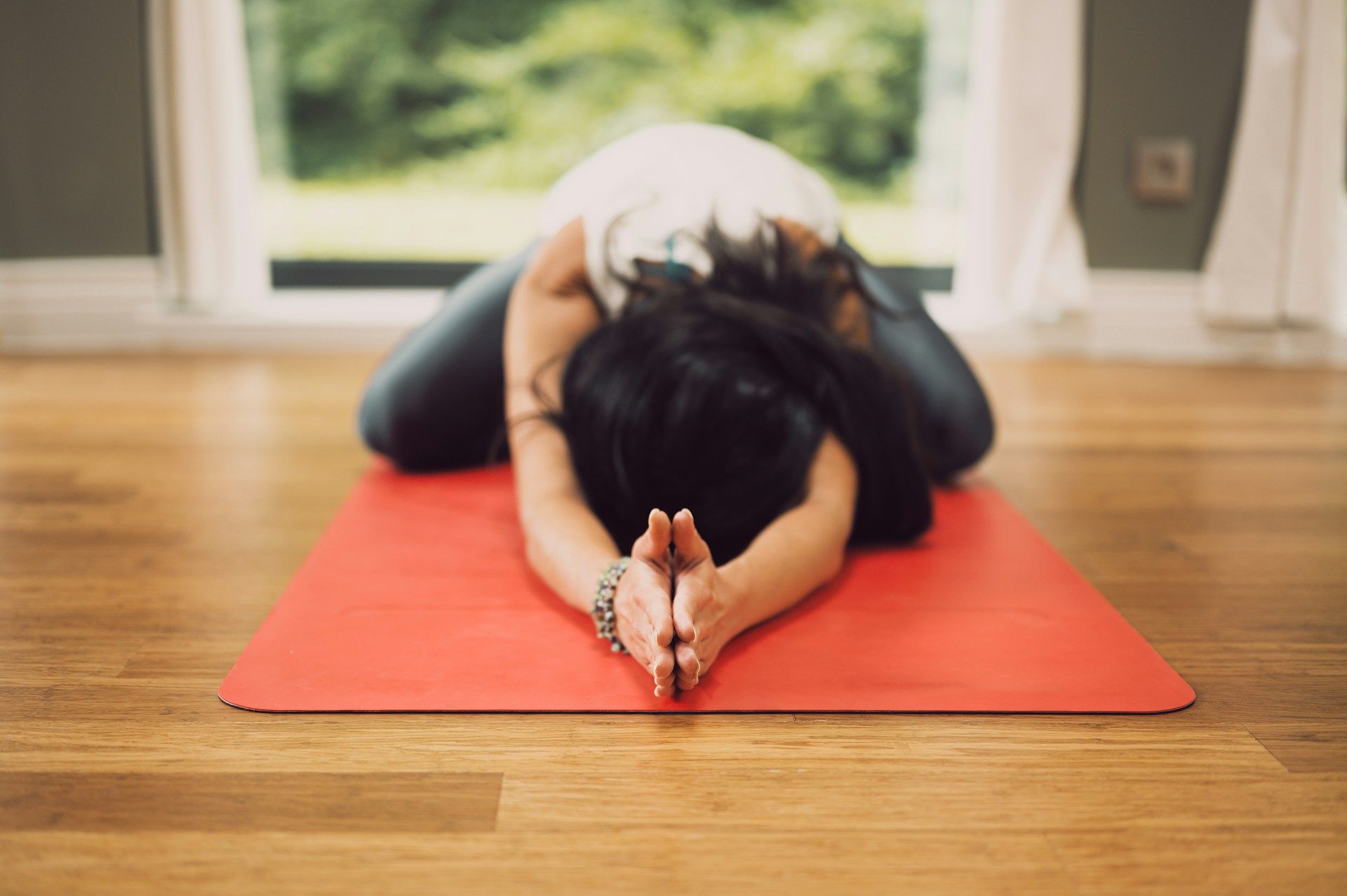
Otherwise, taking a child’s pose or an easy sukhasana seat is another option. Join back in when you feel ready.
Finally, you can modify many poses. We at Only in Sedona Yoga have been working on a series of short videos to introduce you to many of these variations, but you can also get creative, especially if you have a background in anatomy and physiology. You are, after all, the best judge as to whether a given pose is dangerously painful or “hurts so good." Use your mat time as your chance to learn something about your body and yourself.
Using Props When You Can’t Get Into a Yoga Pose
Props can help you get into yoga poses and make them more comfortable and passive for longer Yin and restorative asanas.
Often,everyday household objects work as well or better than professionally branded props, so get creative with your couch cushions, blankets and towels. You can fold and stack the latter two into nearly any configuration to support your knees, hips, back and other joints during your practice.
Deep Dive on Props and Pose Variations: Forward Fold
Here’s a primer on how you can use different variations of the same pose along with assorted props to make forward folds work for you despite any physical challenges you may face:
For Standing Forward Folds
- Use blocks. Place blocks on either side of your feet and use them to catch your hands in standing forward folds to decrease the pressure on your lumbar spine, especially if your fingertips don’t quite reach the floor, You can flip them the tall way and move them to the short side as you increase in flexibility.
- Up against the wall. If hinging forward from your hip puts too much pressure on your lumbar spine, begin by placing your hands against a wall instead. Step backward, keeping your spine straight, until your body forms an upside-down letter “L.” Use the wall to support your upper body as you tune into the release in your hamstrings.
For Seated Forward Folds
- Use a strap. Wrapping a strap around your feet frees you to lengthen your hamstrings without rounding your lumbar spine.
- Use pillows, bolsters and blocks. Piling pillows and bolsters against your low belly can prevent your lower back from rounding too much in this pose if you have lumbar problems. Additionally, supporting your head on blocks lets you lean forward without neck strain.
Or Make It Supine
- Use a strap here, too. Use a strap during single-leg supine hamstring stretches to release the back of the thighs with no pressure on your lumbar vertebrae.
- Or move toward snail. You can reach for your hands with your calves or use the weight of your legs alone, leaning them back toward your head as if you were going to go into snail pose, to elongate the backs of your thighs.
What You Should Do When You Can’t Get Into a Yoga Pose
Relax, beautiful fellow yogi. There’s no shame in yoga. Read that again.
There’s no shame whatsoever in your yoga practice.
If you still feel shame from not being able to get into a yoga pose, this mental trick might help: try flipping the equation on its head.
You could just as easily say, “this pose is not the right fit for my body.” It’s not the pose that’s the problem. Likewise, it’s not your body that’s at issue. It’s just an incompatible configuration, one that a few minor adjustments or tools might help to connect.
Yoga means “union” — in an infinity of beautiful ways. One interpretation of “yoga” is the union between your physical self and your external reality. Maybe you can’t fit into certain shapes in your present form, and that’s perfectly okay! You wouldn’t shame yourself for your inability to fit into a shoebox once you outgrew infancy. Why feel bad for being unable to get into a full lotus pose if your hip configuration simply does not allow it?
Relax, and Let Your Flow Flow
Therefore, simply relax, beautiful fellow yogi, and get into your flow. Mindfully tune into your body and let it guide you. Rather than trying to imitate your instructor’s moves perfectly, perform them in a way that feels like healing medicine to your unique mind, body and spirit.
With much love and hope for healing, always. ~ J.
References:
[1] Cathe. “What genetic factors determine the shape of your muscles and how strong they are.” Nd. Retrieved March 30, 2026, from:https://cathe.com/what-genetic-factors-determine-the-shape-of-your-muscles-and-how-strong-they-are/
[2] Beckencamp, Paula R., et. al. “Benefits and harms of exercise therapy and physical activity for low-back pain: An umbrella review.” NIH, Pubmed Central. April 2, 2025. Retrieved March 30, 2026, from: https://pmc.ncbi.nlm.nih.gov/articles/PMC12191304/