How to Avoid Rumination While Using Restorative Yoga in Your Healing Journey
Your mat is a sacred place of rest, not a quest to Mt. Doom.
Talking to your mat is the perfect way to calm yourself. Soothing a jangled nervous system is often the first step toward getting out of your limbic brain and into your wise mind.
However, even though long, slow poses can soothe you and create space for clearer thoughts to arise, they can also invite rumination. Before you know it, you’re on a mental journey to Mt. Doom.
Rumination is like a vampire in that it drains you. It’s not at all conducive to healing—so how do you stop it? This guide and the following tips can help.
As always, the requisite caveat: we at Only in Sedona Yoga are not licensed health care or therapy practitioners. We are fellow patients on a healing journey.
Step One: Sanctify Your Space
Your anti-rumination work begins before you even set your intention by creating a safe, quiet, serene space for your practice. For those with the luxury of their own room, setting aside a 5’ by 8’ sacred practice area is ideal. Use room dividers, mirrors and plants to create division and the illusion of a spacious, natural setting.
In a perfect world, everyone would get a room of their own with a bit of an exterior courtyard for yoga practice or simply for existing. However, that’s not where we live. Some of us live with codependent or intrusive family members and roommates.
If that’s your situation, and you can’t create a safe space at home, can you find one elsewhere? I’m a huge fan of taking my practice into nature. However, a quiet corner of your neighborhood gym or community center can do in a pinch. Some facilities allow members to use the fitness studio space when group classes aren’t in session, and even if others enter during your flow, they’ll generally leave you be. Get creative! Even a “Harry Potter-esque” storage space beneath your stairs can become a sanctuary for a restorative or Yin practice.
The idea is, once you step inside this space, you leave the outside world—along with its frustrating tangle of demands, pressures, deadlines, and expectations behind. Your space should feel like entering church. Your mat is your sacred space to commune with Divinity as you understand it, so find or build a sanctuary that welcomes you with a sense of “aah.”
Step Two: Set an Intention
Establishing the proper mindset for each yoga session begins with your intention. I like to think of my intention as an invitation to the Universe, to Divinity as I understand it. I am here, I trust in you, I come to you to work hand in hand with you towards this purpose.
That purpose may include nothing more than deep relaxation, which is honorable in and of itself. Calming your nervous system empowers you to get in your wise mind, to balance your
emotions with your reason, which facilitates clearer decision-making on and off the mat. Your intention may be short, sweet and simple: I remain anchored through my breath.
Of course, you can set any intention that you like. The most effective intentions are affirmative, positive statements, worded if what you intend to bring about is already happening. For example, instead of saying, “I want to feel more peaceful and serene,” try, “I invite peace and serenity into my heart.”
Step Three: Create a Breath Mantra
I’m forever grateful to the teachings of Thich Nhat Hanh and his work at Plum Village. I cannot count how many times I have turned to his simple mantra of, “Breathing in, I am aware that I am breathing in; breathing out, I am aware that I am breathing out,” to center myself amid chaos.
Your breath is your most powerful tool in your anti-rumination arsenal. Returning your awareness to your inhales and exhales can break an obsessive thought chain. Once you become better at “catching” yourself before taking off down the mental road to Mt. Doom, you might even notice how you hold your breath or begin breathing more shallowly and rapidly when stressed.
A breath mantra is just a simple phrase—such as “breathing in, I am aware that I am breathing in”---that pulls you back to this state of awareness. It’s a spoken or silent internal cue to slow down, to direct your attention toward breathing into the muscles and connective tissues currently under pressure. Your breath mantra might be something like, “breathing in, I remember in this moment, I am safe. Breathing out, I give thanks for this space to recover.”
Step Four: Establish a Sensory Check-in Cue
Even the most noble of human intentions can veer off course. However, there’s an app for nearly everything these days, and timers are among the most simple and free. If you’re using your computer or phone for your flows, here’s a free site where you can set an interval timer to provide an auditory clue to hop off the rumination train and tune back into your breath and your mantra.
If you have an Apple Watch or other fitness wearable, use the timer function on it as a silent sensory cue. This hint works well when you practice in a group setting, too, as no one else can feel the vibration on your wrist. I like to set mine to remind me every 30 seconds or so, but you can choose whatever interval works best to keep your mind from ruminating while holding long poses.
Tools for Warding Off Rumination Vampires
A fitness wearable is one tool you can use. Here are five others to consider when planning a long restorative session.
1. The Right Music
Lately, I have been absolutely obsessed with the handpan. I don’t know what it is about this relaxing instrument, but I adore it, and tuning into the gorgeous music it creates transports me right out of this world and into a more peaceful and beautiful one.
You can use any music you like. The magic of earbuds makes it possible to practice your flows at 2 am without upsetting your roommates. It also provides a clearer, more immersive sound experience. Singing along can also break a rumination chanin, so hey—if yoga accompanied by metal is your jam, crank it and play a little air guitar while you lie in bananasana (we won’t tell).
2. The Right Temperature
The heat in a hot yoga class may loosen stressed muscles and leave them feeling like delicious warm taffy [2]. It’s also harder for your mind to wander when you’re focused on a mild discomfort, like sweating, so see if turning up the thermostat a bit eases your urge to ruminate.
That ice-cold water bottle also offers aid. According to Dr. Haley Nelson, PhD, splashing cold water on your face activates the mammalian dive reflex. This dials down
your sympathetic nervous system (fight or flight) response and cranks up the parasympathetic half, which helps you rest and digest [3]. The mild shock to your system may be just the trick to snap you out of a rumination chain.
3. The Right Company
It’s no secret that I prefer to practice yoga alone. Even before being diagnosed with autism, I have craved solitude, hungering for it like a dehydrated dandelion in the 1930s dust bowl.
However, the company of others is magnificent for preventing rumination. Have you been moodier and more introspective than usual lately? Shaking up your “mat game” by catching a new class in a studio instead of in front of the TV might be the change of venue you need to reconnect with your Zen. Sometimes, the simple act of flowing with others, even if you don’t converse, is enough to keep you in the present moment.
4. The Right Playful Mindset
Here’s a trick that helped me enormously a few years back. If there’s one thing my untamed brain did to perfection, it was ruminating. Now that I am sober and have recovered my memory, it's even easier for me to time-travel back into the past—but I’m not going that way.
I’m also used to thinking of my brain as a separate entity, which makes this trick even easier: Make it a game to catch yourself ruminating. Assign no judgment, no, “oops, I did it again,” to each time you catch yourself. Just pretend your rumination chains are Pokemon. Gotta catch ‘em all. It sounds silly, and maybe it doesn’t work for all brain types, but it helped me considerably.
5. The Right Distraction
Here’s some maverick advice that may upset some traditional yogis. What can I say? While I had a more traditional Ashtanga introduction to the mat in my younger years, talking to the mat only became sacred to me when I needed it to heal myself. Therefore, I take an unconventional approach. I’m not saying my methods work for everyone, but if you find them helpful, then my time spent writing this article was worth it.
Dig into a distraction. Please don’t doomscroll—especially nowadays, as the news can be so very triggering—but keep your Kindle handy. Got a TV and a phone? Tune into an educational video for your mind while your body flows.
Using this method helped me enormously in my own healing journey. I’d do hours of restorative yoga while watching various licensed psychologist’s channels and university lectures on various aspects of health, mental and physical. Easing my aches while focusing my mental energy on learning something new prevented rumination
and taught me quite a bit about myself and how to drive my rather unusual brain.
Avoiding Rumination While Practicing Restorative Yoga
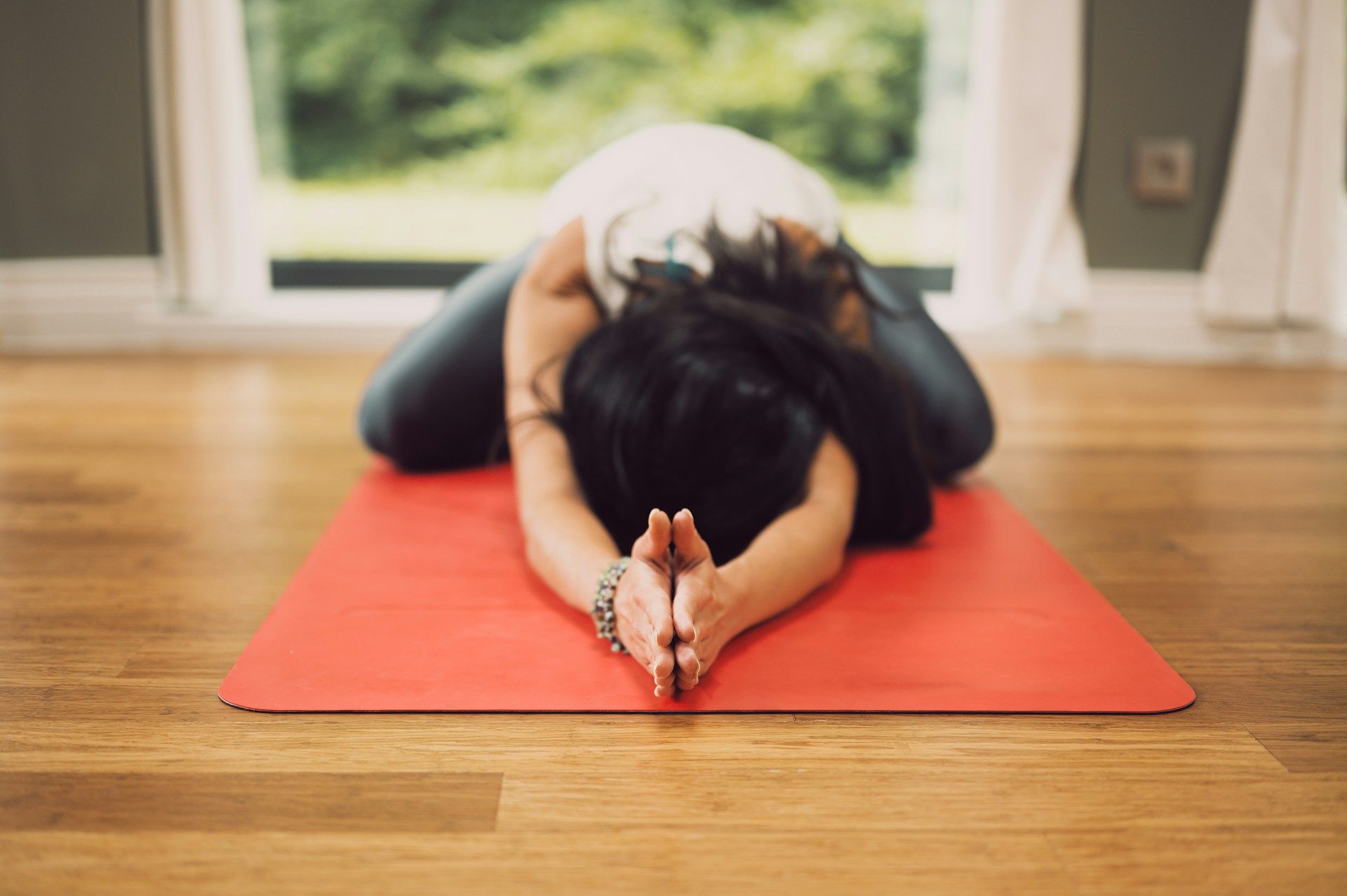
Restorative yoga is much like a deep tissue massage you can give yourself for free. It’s relaxing and healing for your muscles and connective tissues, but it can leave your mind with ample time to wander down the rumination trail to Mt. Doom.
If rumination keeps you from indulging in your practice, give the above tips a try the next time you take to your mat for a quiet talk. Let us know what works for you and feel free to share your ideas with the community in the comments.
References:
[1] “Wise mind v. rationalization: Balancing logic and emotion in DBT therapy.” Palo Alto University. N.d. Retrieved April 14, 2026, from:
https://paloaltou.edu/resources/business-of-practice-blog/wise-mind-vs.-rationalization-balancing-logic-and-emotion-in-dbt-therapy
[2] Gordon, Sherri. “Different Types of Hot Yoga and Their Benefits Explained.” Health. February 16, 2026. Retrieved April 14, 2026, from: https://www.health.com/hot-yoga-11788434
[3] Sardinha, Emily Laurence. “I’m a Neuroscientist, and this 10-Second Habit Can Instantly Boost Your Focus.” Parade. June 8, 2025. Retrieved April 14, 2026, from: https://parade.com/health/10-second-habit-to-boost-focus-according-to-neuroscientist